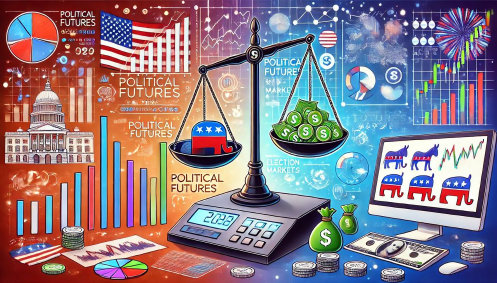
Political futures are tradable contracts that pay out based on the outcome of political events. You can buy a contract that pays if a specific candidate wins an election, if a policy passes, or if a government falls. The price of the contract reflects the market’s real-time probability estimate of that outcome.
These markets work because they force people to put money behind their opinions. It is easy to tell a pollster you think a candidate will win. It is different when you have to risk capital on it. That financial incentive filters out noise and aggregates information in ways that traditional polling cannot match. When thousands of participants with different information sources and analytical frameworks all trade against each other, the resulting price tends to be a better predictor than any individual expert or model.
The concept is not new. Intrade was the most prominent platform for years, allowing global participants to trade contracts on US elections, policy decisions, and geopolitical events. It shut down in 2013 due to regulatory issues. TradeSports offered similar products. In the UK, betting exchanges like Betfair have always allowed political wagering and remain active. More recently, platforms like Polymarket and Kalshi have brought prediction markets back into the mainstream, particularly around US elections.
The track record is strong. Prediction markets called the 2008 and 2012 US presidential elections more accurately than most polling averages. They priced in Brexit risk earlier than conventional wisdom suggested. During the 2024 US election cycle, prediction market odds moved faster and more decisively than poll aggregators because they incorporated information like early voting data, fundraising numbers, and ground-level reporting that polls miss.
Where political futures get interesting for traders is in the connection to financial markets. Elections move currencies, bonds, and equities. If you can price the probability of a political outcome more accurately than the market, you can position ahead of the move. A trader who correctly assessed the probability of Trump winning in 2016 and bought dollar, sold peso, and went long equities before election night captured one of the largest overnight moves in recent market history.
The criticism of political futures centers on ethics and manipulation. Should people profit from political outcomes? Can wealthy participants move the market to create a narrative that influences actual voters? These are legitimate concerns. But the empirical evidence suggests that prediction markets are remarkably resistant to manipulation because any attempt to push prices away from true probabilities creates an opportunity for informed participants to trade against the manipulator and profit.
For anyone trading macro, political futures are not a sideshow. They are an essential input. Elections, referendums, policy shifts, and regime changes move trillions of dollars in capital flows. Having a real-time probability estimate of these events, backed by actual capital at risk, is more valuable than any pundit or polling model.